Introduction
You have an egui_dock app with three panels and they keep fighting over
state. Two panels both render every frame, both write to the same bool,
and whichever rendered last wins. You add a "currently active panel"
field somewhere; every panel polls it and tries to react to changes.
The polling code multiplies. Adding a fourth panel means touching three
existing ones.
egui_citizen fixes this. It gives each panel a persistent identity,
reactive lifecycle state, and a central dispatcher that routes
activation through an encoded set/reset — exactly one panel active at
a time, atomically, no per-frame races.
But the panel race is just the entry point. egui itself is, by design, a primitive — its own README is direct about that:
egui is not a framework. egui is a library you call into, not an environment you program for.
That is true and intentional. It also leaves an obvious gap. The egui community has produced excellent individual components, but a kit of components is not a framework. There is no widely adopted opinionated way to organize a non-trivial egui app — where state lives, how panels coordinate, how the UI talks to backend threads.
One of those individual components deserves explicit recognition.
egui_dock is the key piece of
the egui ecosystem that lets a non-trivial app look and feel
finished — multi-panel docking, splittable workspaces, drag-and-drop
tab rearrangement, persistent layouts. It plays roughly the same role
in the egui world that the Qt Advanced Docking System plays in Qt:
without it an app tends to feel like a demo, and with it an app can
feel professional.
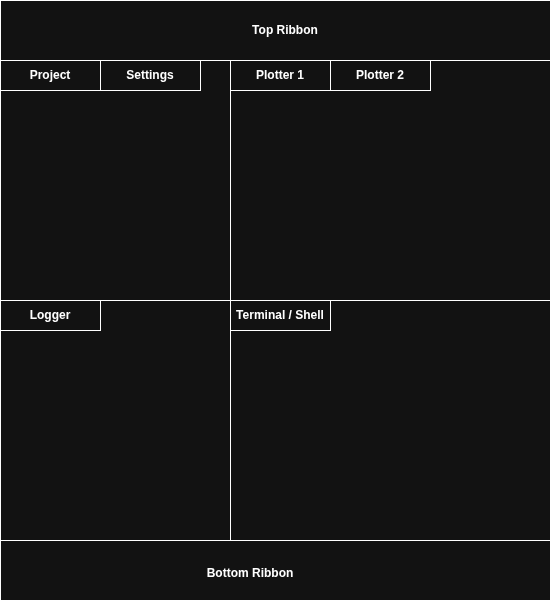
A typical multi-panel app layout. Every labelled region is a candidate citizen-panel; the ribbons are app-shared chrome.
But egui_dock is, by intent, a layout and interaction primitive — not
an organizational framework. It hands you the shell. It does not tell
you how the panels living inside that shell should share state,
coordinate activation, or reach a backend. Wiring those decisions is
left to the application author, which is precisely what this book —
and egui_citizen — are about.
egui_citizen fills that gap. It is, in practice, a framework for
organizing egui apps — clean, reusable, and easily expandable.
Persistent identity, reactive state, and central message dispatch form
a small composable kit of building blocks that scale as the app grows.
It evolved from egui_mobius in direct response to that ecosystem
gap (the Lineage section covers the technical
inheritance); CopperForge and other real applications are built
end-to-end on these primitives.
This book teaches the design vocabulary and the non-obvious rules. By the end you should know:
- Where each piece of state in your app belongs (
CitizenState, panel-local fields, or app-shared services). - What "reactive" actually means in this codebase, and what cloning
a
CitizenStatedoes (and doesn't) do. - When to keep panels stored on your app struct vs. construct them per-frame — and which trap will silently break the second form.
- How to forward citizen lifecycle events to backend threads without the UI having to know about them.
Who this book is for
Rust developers building dockable egui applications. Familiarity with egui itself is assumed — this book is not a tutorial on
egui::Uioregui_dock. It is a guide to usingegui_citizento organize a real app on top of those.
Key vocabulary
Three terms appear throughout this book. Fix them in your head now — every chapter that follows leans on these:
- citizen-panel — a dock panel that carries a persistent identity
(
CitizenId) and reactive lifecycle state (CitizenState), wired into a centralDispatcher. The citizen-panel is the unit of organization in anegui_citizenapp. - atom — a single widget inside a citizen-panel: a slider, a button, a text field, a checkbox. Atoms are where user input originates. They fire events on their citizen-panel's behalf and often hold their own reactive state that other panels or backend threads read. See the coupling chapter for how an atom can wire into panel-to-panel state sharing, panel-to-backend messaging, or both at once.
Dynamic<T>— the reactive primitive that citizen-panels and atoms both sit on top of. A thread-safe, observable cell that any number of handles can point at. Writes through any handle are visible through every other handle. Covered in depth below.
Lineage
egui_citizen evolved from
egui_mobius, a broader
reactive framework for egui. It now stands as its own architectural
framework, with one piece of that lineage retained as a hard
dependency: the
egui_mobius_reactive
crate, specifically its Dynamic<T> type.
The Dynamic<T> primitive
Before going further, know the one building block that everything
reactive in egui_citizen rests on:
Every reactive field in
egui_citizenis aDynamic<T>.
What it is
A Dynamic<T> is a thread-safe, observable container for a single
value. Internally (quoting egui_mobius_reactive verbatim):
pub struct Dynamic<T> {
    inner: Arc<Mutex<T>>,
    notifiers: Arc<parking_lot::Mutex<Vec<Sender<()>>>>,
}
Two Arcs. The first holds the value behind a standard Mutex. The
second holds a list of channel senders used to wake subscribers when
the value changes. Dynamic<T> derives Clone — cloning bumps the
refcount on each Arc and copies nothing else, so every clone refers
to the same storage and the same notifier list.
Aside:
Clonein Rust is per-type. Rust has no language-level default of "deep" vs. "shallow" — each type'sCloneimpl decides what cloning means for that type.
- Owned types like
String,Vec<T>,Box<T>,HashMap<K, V>duplicate their heap data on.clone()— what C++ would call a deep copy.- Reference-counted types like
Arc<T>andRc<T>are documented to clone as a refcount increment — a new handle pointing at the same allocation. C++ would call this shallow.
Mutex<T>itself does not implementCloneat all — that is why theArcwrapper is necessary. Cloning aDynamic<T>is therefore exactly twoArc::clonecalls: two refcount bumps, zero data duplication. The shared storage is not an accident; it is the precise contract ofArc.
Core API
use egui_mobius_reactive::Dynamic;

let counter = Dynamic::new(0);      // construct
let n = counter.get();              // read (clones T out of the lock)
counter.set(42);                    // write, then notify listeners
let mut guard = counter.lock();     // direct MutexGuard if you need it
*guard += 1;Dynamic::new(initial)— requiresT: Clone + Send + 'static.get()— returns a clone of the value; the lock is released before you work with the result.set(value)— takes the lock, writes, drops the lock, then sends()into every registered notifier channel.lock()— gives you a rawMutexGuardfor in-place mutation. Other readers and writers block until you drop the guard.
Observing changes
Reading on every frame works — that's what UI panels do via .get()
in their render methods. For event-driven work, ValueExt::on_change
registers a callback that fires on every mutation:
use egui_mobius_reactive::{Dynamic, ValueExt};

let counter = Dynamic::new(0);
counter.on_change(|| println!("changed!"));

counter.set(1); // prints "changed!"
counter.set(2); // prints "changed!"
Under the hood, on_change spawns a dedicated background thread that
waits on the notifier channel. The callback runs off the UI thread —
which is why T needs Send + Sync + PartialEq + 'static for this
path. The full mechanics — including what it actually costs per
subscriber and why the canonical reactive path inside egui_citizen
is panel-side polling rather than callbacks — get a chapter of their
own: Inside Dynamic<T>.
Why this shape matters for egui_citizen
Because clones share storage, a CitizenState — a bundle of
Dynamic<T> fields — is a handle, not an owned value:
#![allow(unused)]
fn main() {
use egui_citizen::CitizenState;

let a = CitizenState::new();
let b = a.clone();

a.active.set(true);
assert!(b.active.get());  // true — same Arc<Mutex<bool>>
}
The dispatcher keeps one clone of each citizen's state; your panel
holds another. When the dispatcher writes .active.set(true), your
panel sees true on its next .get(). No event bus, no subscription
to wire up, no polling loop — just a shared Arc.
Permissive type, disciplined use
Dynamic<T> itself is multi-producer, multi-consumer — any clone
can call .set(), any clone can .get(). The type doesn't restrict
who writes.
egui_citizen layers a single-writer-per-field discipline on top:
| Field | Canonical writer |
|---|---|
active | The Dispatcher (via activate) |
clicked | The panel's on_click hook |
selected, visible, moved | The panel or app-level code |
location | The dock-integration layer |
Readers are unrestricted: any panel, any backend thread. Writers are by convention, not enforcement. This is why the dispatcher is central (it's the one place that serializes activation writes across all citizens), and why the pitfall on two dispatchers in one app exists — two writers to the same logical field break the one-hot invariant.
Keep to "one writer per field" and the reactive story stays clean; violate it and you're back to the per-frame race the crate was built to avoid.
Where it sits in the wider crate
egui_mobius_reactive also provides Value<T> (an older API with the
same idea), Derived<T> (computed values that recalculate when their
inputs change), and a SignalRegistry for app-wide signal wiring.
egui_citizen uses only Dynamic<T>, so that is all this book
covers. If you later want a Derived<T> that reads a CitizenState
field and recomputes downstream, the reactive crate's own documentation
is the next stop.
The chapter on reactive lifecycle builds on this
foundation and walks through the trap that bites users who construct a
CitizenState with CitizenState::default() instead of obtaining one
from Dispatcher::register().