Coupling
Panel-to-panel coupling is what shared Dynamic<T> already gives you:
one panel writes, another reads, egui redraws on the next frame.
Most apps need nothing more than that to get state from one panel to
another. This chapter calls that Path A, and it is the default.
There is also an opt-in second path — the outbox — for the
specific case where a state change needs to leave the UI thread or
land on a queue: a backend thread, an off-thread logger, a persistence
sink, anything that wants events rather than just the current value.
That's Path B. The panel pushes an AppMessage onto its outbox;
the app's update loop drains it and the citizen's actions module
routes it onward. Most of this chapter exists to keep its trade-offs
straight from Path A's, because conflating the two is where designs
go sideways.
A single widget — what we'll call an atom (a widget inside a citizen panel) — can use either path or both at once.
| Path | Mechanism | Good for | Timing |
|---|---|---|---|
| A | Shared Dynamic<T> | Panel ↔ panel (default) | Immediate |
| B | Outbox + actions | Panel → backend / logger | Next drain pass |
Path A — shared Dynamic<T> (panel to panel)
Two panels share a clone of the same Dynamic<T>. One writes, the
other reads. That's the whole mechanism.
// settings_panel.rs
struct SettingsPanelState {
    pub slider_value: Dynamic<f32>,
}

// logger_panel.rs
struct LoggerPanelState {
    pub observed_slider: Dynamic<f32>, // clone of settings.slider_value
}
The two Dynamic<f32> handles point at the same Arc<Mutex<f32>>.
When settings calls .set(...), the write lands in shared memory.
When logger.ui() runs on the next frame and calls .get(), it sees
the new value.
No subscription, no callback, no event bus. egui already redraws frequently enough that polling-per-frame is effectively free. Path A carries state, not events.
Path B — outbox messages (panel to backend, opt-in)
The settings citizen explicitly enqueues a message on its own outbox;
the app's update loop drains it after DockArea::show() and the
citizen's actions module forwards it onward — to a backend thread, a
logger sink, a persistence layer.
// In citizens/settings.rs, when the slider changes:
self.outbox.push(AppMessage::SliderChanged(local));

// In App::update(), once per frame:
for msg in std::mem::take(&mut self.settings.outbox) {
    settings_actions::handle(msg, &self.state, &mut self.backend);
}

// In settings_actions.rs — the dispatch path:
match msg {
    AppMessage::SliderChanged(v) => tx_backend.send(v).unwrap(),
    // ...
}
Path B carries events, not state. Each push enqueues one record;
the drain consumes the queue. Nothing is "shared" — the message is a
value, not a handle. The registry is not involved: its own queue
carries CitizenMessage lifecycle events only, and a backend thread
never touches either queue directly — the actions module forwards
over a channel or signal.
Aside on
Dynamic::on_change.egui_mobius_reactivedoes provide a callback-style subscription onDynamic<T>itself, which looks superficially like a third coupling option. It is — but it spawns one OS thread per subscriber, has no unsubscribe API, and doesn't coalesce wakeups. For mostegui_citizenapps, Path B through the outbox is the better way to do "react off the UI thread when this value changes." The full mechanics live in InsideDynamic<T>.
Atoms can wire to both
A single atom can fan out to both paths from the same user event. The fan-out happens at the change handler:
if ui.add(Slider::new(&mut local, 0.0..=100.0)).changed() {
    self.slider_value.set(local);                        // Path A
    self.outbox.push(AppMessage::SliderChanged(local));  // Path B
}
This is a common and correct pattern. The atom is the single write site; each path is a derived consequence of the one event. Readers on Path A see the new value next frame; consumers on Path B get the message on the next drain cycle.
When dual wiring is right
Dual-wire an atom when a change needs to:
- Update shared UI state, and
- Trigger side-effect work (log it, persist it, send it to a backend thread, recompute a derived value off-thread).
Single-path atoms are fine when the change only needs one of those. Don't dual-wire out of habit — extra messages with no consumers are noise.
Source-of-truth discipline
The trap: once an atom writes to both paths, downstream code can read from either one and the two representations can drift. Pick a discipline and hold it.
Discipline 1 — Dynamic<T> is canonical, the message is a ping.
self.outbox.push(AppMessage::SliderChanged);  // no value in the message!
// Consumers re-read `settings.slider_value.get()` when the message arrives.
Consumers of the message reach back into shared state for the current
value. This guarantees consistency — there is exactly one value, the
one in the Dynamic<f32>. The message says only "something happened,
go look."
Discipline 2 — Message carries the value, Dynamic<T> is a UI mirror.
self.outbox.push(AppMessage::SliderChanged(local));The message is the canonical record of the event. The Dynamic<f32>
exists only so other panels can render the current value without
intercepting messages. Consumers of the message trust the message and
do not re-read the Dynamic.
Either discipline works. Mixing them silently — some consumers
trusting the message, others reading the Dynamic — is where bugs
live.
Timing
Within a single frame, the two paths do not tick in lockstep:
- Path A is instant.
.set(v)returns after writing; any panel calling.get()on a clone seesvimmediately. - Path B is queued. The push appends to the citizen's outbox; consumers don't see it until the update loop drains the outbox and the actions module forwards it.
Backend threads therefore observe the Path B message after the UI has already observed the Path A value. For typical use (the backend does work and replies asynchronously), that one-frame gap is invisible. For anything tighter — a dependency on in-frame ordering between UI and backend — you need to redesign, not lean harder on this.
The registry is not a reactive bus
Worth saying explicitly, because it is the mistake everyone makes coming from other reactive systems:
The registry does not observe
Dynamic<T>writes.
It only knows about the CitizenState fields it registered, and its
queue only fills from activate() and explicit send() — and that
queue carries CitizenMessage lifecycle events, never your app's
domain messages. Your slider's Dynamic<f32> is invisible to it,
and your AppMessages never pass through it at all.
Shared state (Path A) and outbox messages (Path B) compose — they don't chain automatically.
Citizens as a propagation graph
Step back from the mechanism for a moment. What shape does an
egui_mobius application actually have at runtime?
It's a graph. Citizens are the nodes; Dynamic<T> cells are
the edges. Off to the side sit two coordinators with sharply
different jobs: the registry knows which citizen is active and
carries no data at all, while the dispatcher — the aggregate of
the outbox drain and the actions modules — is the outbound hub that
carries events to the backend.
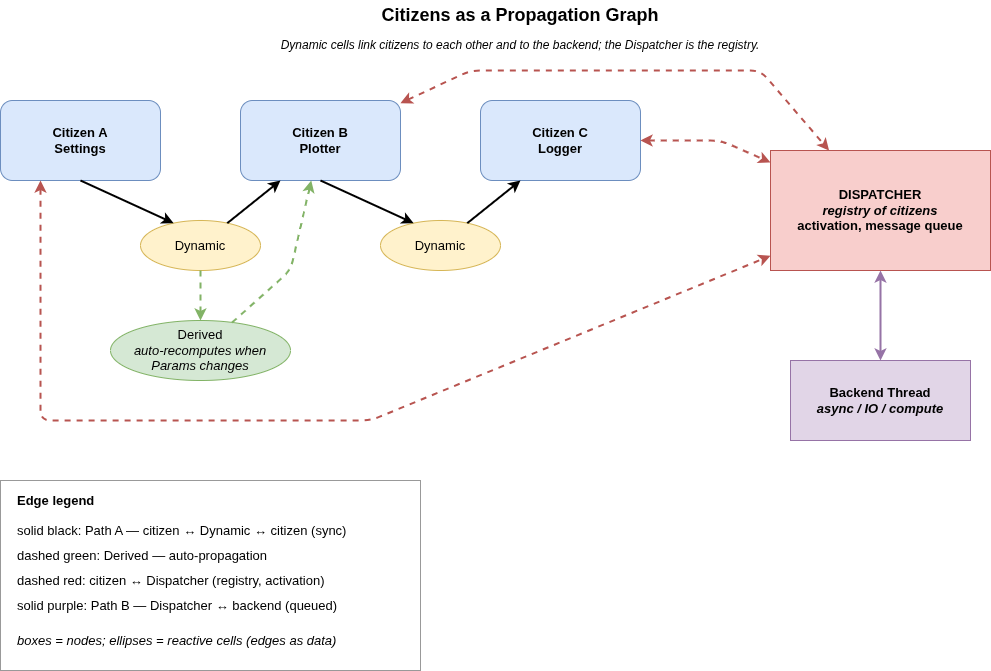
Three propagation modes ride this graph:
-
Adjacent. A citizen writes
Dynamic<T>, an adjacent citizen reads it on the next frame. Sync, in-frame, no queue. This is Path A from the previous section. Two panels sharing a slider value, a selection set, a cursor position — that's adjacent propagation. Topology is whatever clones share the sameArc-backed cell; siblings, cousins, however far apart in the panel tree, all see the same value. -
Forward. A
Derived<T>cell wraps aDynamic<T>and recomputes automatically when the input changes. The new value flows downstream to whoever holds a clone of theDerived. This is the chain in the graph: input cell → derived cell → readers. Useful when one citizen owns the source-of-truth state and other citizens want a transformation of it without each computing the same transform locally. -
Outbound. A citizen pushes onto its outbox; the app drains it and the actions module dispatches over a channel or signal to a backend thread. Async, queued, next-drain. This is Path B — drawn in the figure as the dispatcher block, the aggregate of drain plus actions. The graph extends past the UI thread out to whatever does the heavy lifting — IO, compute, network — and the backend's responses come back the same way: through the dispatcher boundary, landing as writes into
Dynamic<T>cells the UI reads next frame.
The combination matters. Most reactive frameworks bind state to a
component lifetime: state lives inside the widget tree, and
sharing across siblings means lifting up or threading context. The
egui_mobius model inverts that. Dynamic<T> cells are
free-standing reactive nodes anyone can hold a clone of —
including backend threads that don't have an egui context at all.
The widget tree borrows the cells; it doesn't own them. That's
why the same primitive that wires Settings to Plotter also wires
Plotter to a Tokio task.
The neural-network analogy is approximate but useful. A citizen graph propagates values to adjacent neighbours through cells and forward through derived chains. The registry is more like a directory than a layer — it doesn't compute or carry data, it just knows who's plugged in and which node is active. The dispatcher is the graph's edge to the outside world: outbound events flow through it to the backend and results flow back. The actual data movement inside the graph happens through the cells.
Summary
- Two coupling paths. Path A for UI-to-UI state sharing (shared
Dynamic<T>). Path B for UI-to-backend events (outbox push + drain + actions dispatch). - Atoms can wire to one path or both. Fan-out happens at the write site, not downstream.
- Dual-wired atoms require a source-of-truth discipline:
Dynamiccanonical with the message as a ping, or message canonical with theDynamicas a UI mirror. Don't mix. - Path A is in-frame; Path B lands at the next drain. Backend threads see changes one frame after the UI does.
- The registry is a lifecycle registry plus an explicit outbound queue. It is not an automatic observer of reactive state.